




When people compare invisible grilles, one of the first things they usually ask is, “Is it 2 mm or 3 mm?” Price is often another major factor.
But an invisible grille should not be selected by cable thickness or price alone.
An invisible grille is a complete safety system made up of the cable, stainless steel, protective coating, fasteners, anchoring, cable spacing, tensioning and installation workmanship. Every part has a role in how the finished system performs.
At M SPACE, our approach is simple: safety comes first. We focus on the complete installation rather than looking at one component in isolation.
1. Cable Thickness Is Not the Only Factor
A thicker cable does not automatically mean a safer invisible grille.
When comparing cables, factors such as construction, number of strands and wires, stainless-steel quality, metallic cross-section and tested breaking strength are important.
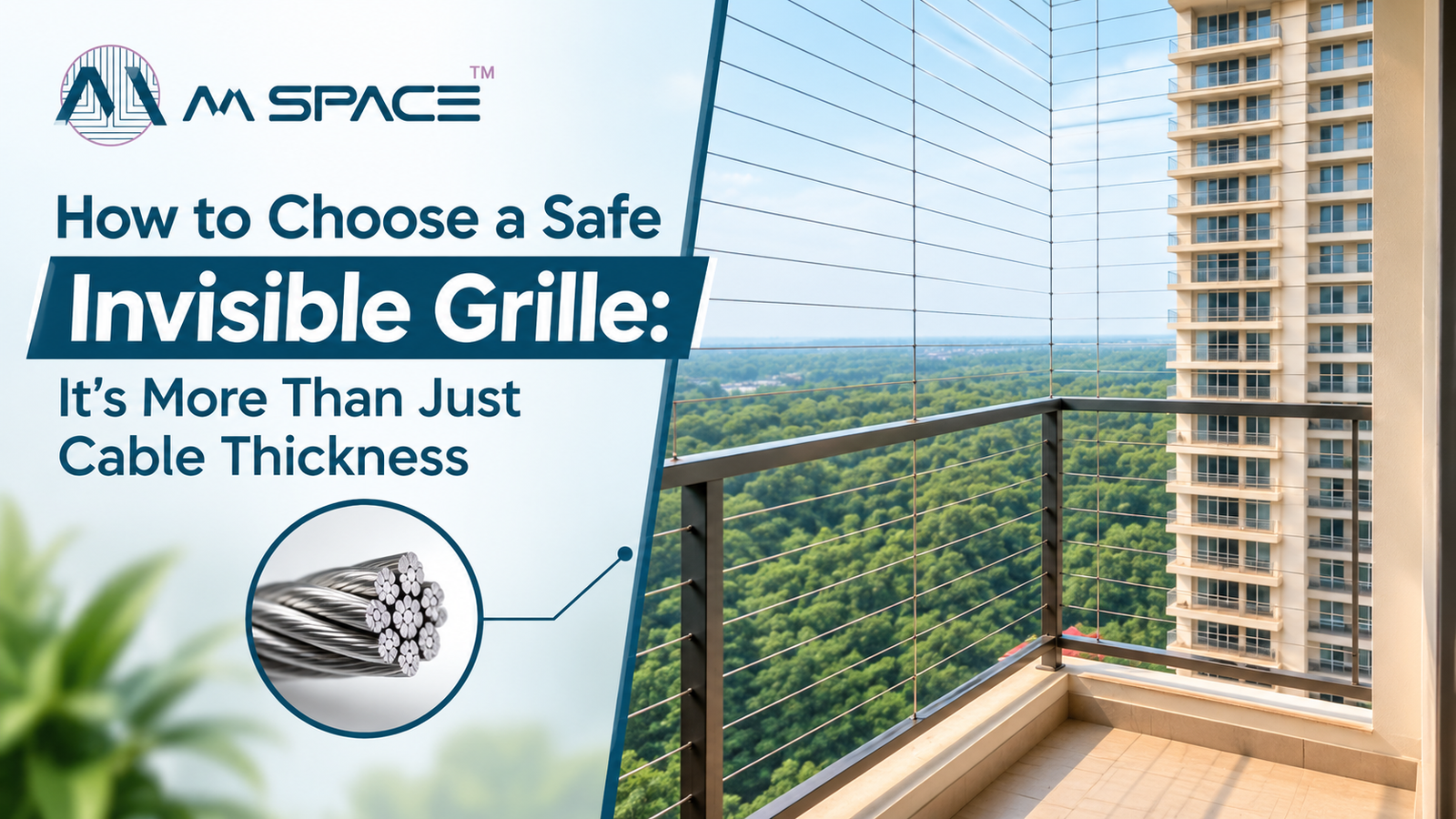
For example, M SPACE uses a 2 mm 7×7 cable for its approved applications. The 7×7 construction means the cable is made using 7 strands, with 7 wires in each strand.
Therefore, customers should look beyond the diameter and ask about the actual cable construction and supporting test documentation.
2. Stainless-Steel Quality Matters
The stainless steel used in the cable affects important properties such as mechanical performance and resistance to corrosion.
However, simply hearing the words “stainless steel” is not enough. The grade and quality should match the approved technical specification for the product.
This becomes particularly important when invisible grilles are installed in locations exposed to rain, humidity, pollution or coastal conditions.
3. The Protective Coating Also Has a Purpose
Invisible grille cables generally have a protective coating that provides an additional surface layer and contributes to the overall finish and handling of the cable.
The quality of this coating matters.
Important factors include:
- Uniform coating
- Good adhesion
- Flexibility
- UV and weather resistance
- Long-term durability
A thicker coating does not automatically mean a stronger cable. The cable and coating need to work together as part of the complete system.
4. Fasteners and Anchoring Are Critical
A strong cable cannot perform properly if it is attached to an unsuitable or poorly installed fixing system.
The fastener type, base material, embedment depth, edge distance and installation quality all influence how forces are transferred into the structure.
Mspace considers systems such as Hilti HRD-C and Klimas KPS for suitable applications. Fixing depth can vary according to the fastener and substrate, so it should be determined based on the actual site and technical requirements.
This is why selecting the right anchor is not something that should be based only on appearance or price.
5. The Surface Being Fixed Into Matters
Every building surface behaves differently.
Concrete, brick, AAC blocks, hollow blocks and steel do not provide the same fixing conditions.
Even a good-quality fastener may not provide the required performance when installed into a weak or unsuitable substrate.
Before installation, the fixing surface should therefore be assessed properly.
Good hardware + unsuitable substrate does not automatically mean a safe installation.
6. Cable Spacing Should Be Planned Properly
Cable spacing affects both the safety function and the appearance of an invisible grille.
The cables should be installed with consistent and appropriate spacing according to the approved M SPACE design and the application requirements.
Spacing should not be decided only by how the grille looks.
A properly planned layout helps maintain a clean appearance while supporting the intended safety function.
7. Cable Tension Needs to Be Controlled
Cable tension is another important part of invisible grille installation.
If the cables are too loose, they may have excessive movement. On the other hand, unnecessary over-tensioning can place additional load on the cable, anchors and supporting structure.
The objective is not simply to make the cable as tight as possible.
The goal is controlled and consistent tension according to the installation procedure.
8. Installation Quality Makes a Difference
Even quality materials can perform poorly when they are installed incorrectly.
Professional installation involves more than fixing cables to a wall or railing.
It can include:
- Correct drilling
- Proper hole preparation
- Correct anchor installation
- Accurate alignment
- Consistent cable spacing
- Controlled tensioning
- Proper cable termination
- Final finishing
The quality of the finished invisible grille depends on how all these elements come together.
9. Every Site Needs a Proper Assessment
There is no single installation condition for every balcony, window or opening.
Before installation, important site conditions should be checked, including:
- Opening dimensions
- Existing railing condition
- Concrete, slab or beam locations
- Available fixing surfaces
- Edge distances
- Visible cracks or damage
- Waterproofing conditions
- Access for installation
This site assessment helps determine how the invisible grille should be installed for that particular location.
10. Final Inspection Should Not Be Ignored
Installation should not be considered complete simply because all the cables are in place.
A final inspection should check important points such as anchor security, cable tension, spacing, alignment, cable termination and overall workmanship.
Similarly, claims about tensile strength or breaking load should be supported by appropriate test documentation, rather than judged by visual appearance alone.
11. Consider the Installation Environment
An invisible grille installed inside a protected area may face different conditions from one installed on an exposed balcony.
Indian weather can include strong sunlight, heavy rain, humidity, pollution and, in coastal areas, salt exposure.
For this reason, the cable, coating, fasteners and other components should be selected according to the actual installation environment.
12. Safety Also Includes Maintenance
An invisible grille should not be treated as a completely maintenance-free product.
Over time, customers should pay attention to signs such as:
- Loose cables
- Damaged protective coating
- Disturbed anchors
- Changes or damage around the fixing area
- Structural modifications near the installation
If any such issue is noticed, it should be inspected and addressed appropriately.
What Should You Check Before Choosing an Invisible Grille?
Instead of asking only “2 mm or 3 mm?”, ask about the complete system.
Consider:
Cable construction + Stainless-steel quality + Protective coating + Fasteners + Anchorage + Base material + Cable spacing + Tensioning + Installation workmanship + Quality inspection
All of these elements contribute to the finished installation.
Choose the System, Not Just the Cable
An invisible grille may look simple because the cables are designed to be visually minimal. But behind that clean appearance is a combination of materials, fixing methods, site conditions and installation practices.
That is why choosing an invisible grille should not be based only on cable thickness or the lowest price.
At M SPACE, we believe that an invisible grille should be approached as a complete safety solution, with attention given to the cable, fixing system, installation conditions and workmanship.
M SPACE — WE DELIVER SAFETY.
