



When choosing an invisible grille, most people look at the cable thickness first. A common question is whether a 2mm cable or a 3mm cable is better for safety.
But cable thickness alone does not tell the complete story.
The actual safety and performance of an invisible grille depend on several factors, including the cable construction, stainless-steel grade, quality of the wires, manufacturing process, coating, tested breaking strength, anchoring system and installation quality.
This is why choosing an invisible grille cable should not be based only on its outside diameter.
Why Cable Construction Matters
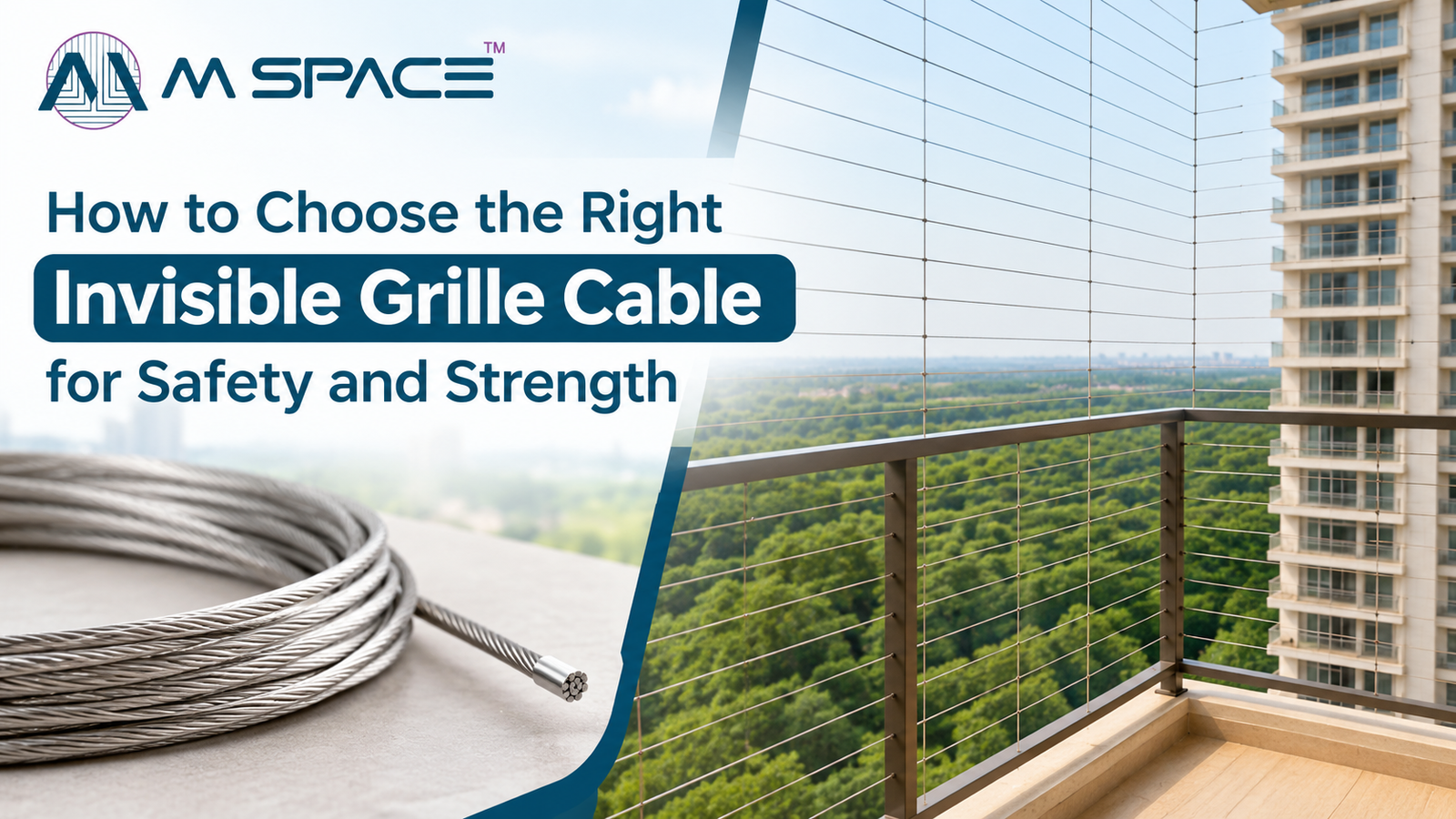
Invisible grille cables are made using multiple individual wires arranged in a specific construction. One such construction is 7×7 cable.
A 7×7 cable generally consists of 7 strands, with each strand made up of 7 individual wires. This means the cable contains 49 individual wires.
This construction can provide a useful balance between strength and flexibility, which is important for architectural wire-rope applications such as invisible grilles.
The construction of the cable affects how it behaves during installation, tensioning and everyday use. Therefore, two cables with different diameters cannot always be compared simply by looking at their thickness.
2mm 7×7 vs 3mm Cable
A 3mm cable is visibly thicker than a 2mm cable. However, this does not automatically mean that every 3mm cable will be stronger or safer than every 2mm cable.
The reason is simple: cables can have different internal constructions and material specifications.
For example, the following factors can differ between cables:
- Stainless-steel grade
- Number and arrangement of wires
- Actual metallic cross-section
- Strand construction
- Coating thickness
- Manufacturing quality
- Tested breaking load
- Quality of end termination
Because of these differences, saying that a 3mm cable is always stronger than a 2mm cable would be an incomplete comparison.
Similarly, saying that a 2mm cable is always stronger than a 3mm cable would also require proper testing to support the claim.
Why Mspace Uses 2mm 7×7 Cable
For an invisible grille, the cable needs to provide the required performance while maintaining the clean appearance that makes the system different from conventional grills.
A properly specified 2mm 7×7 cable can offer a practical combination of slim appearance, flexibility and strength for this type of application.
Its slimmer profile also helps maintain better visibility through the protected area. This is particularly important for balconies and windows where customers want safety without making the space look closed or heavily protected.
However, the cable is only one part of the complete safety system.
The performance of an invisible grille also depends on how the cable is anchored, tensioned and installed.
Stainless Steel Grade Also Matters
The material used to manufacture the cable is another important consideration.
Stainless steel is commonly used for invisible grille cables because it offers corrosion resistance and durability. But not all stainless-steel cables have exactly the same properties.
The stainless-steel grade, quality of raw material and manufacturing process can affect the cable’s performance and service life.
Therefore, when comparing invisible grille cables, it is important to ask not only “What is the cable thickness?” but also “material and construction is being used?”
Breaking Strength Is More Important Than Appearance
A cable may look thick, strong and durable, but its appearance does not tell you its actual breaking strength.
Tested breaking load provides a much more useful way to understand the cable’s mechanical performance.
For this reason, a proper cable specification should consider its tested performance rather than relying only on its diameter.
For safety-related applications, the complete system should be selected and installed according to the required application and engineering considerations.
Installation Is Part of Safety
Even a good-quality cable cannot perform as intended if it is installed incorrectly.
Invisible grille installation involves more than simply fixing cables between two points. Proper anchoring, spacing, tensioning and termination are important parts of the system.
The strength of the complete installation depends on the cable as well as the components holding it in place.
This is why professional installation matters when the invisible grille is being used as a safety solution for balconies, windows or other areas where fall protection is required.
Do Not Choose an Invisible Grille by Thickness Alone
When comparing invisible grille cables, avoid making the decision based only on 2mm or 3mm thickness.
Instead, look at the complete specification:
Cable construction + stainless-steel grade + metallic cross-section + manufacturing quality + tested breaking load + coating + anchoring + installation
These factors give a much clearer understanding of the cable and the complete invisible grille system.
The goal is not simply to install a thicker cable. The goal is to use a properly specified and professionally installed safety system that provides the required protection while maintaining the clean appearance of the space.
The Right Question to Ask
Instead of asking only:
“Is 2mm or 3mm better?”
Ask:
“What is the cable construction, what material is it made from, what is its tested breaking strength, and how is the complete system installed?”
That gives you a more meaningful comparison.
At Mspace, the focus is not on making an invisible grille look strong. The focus is on selecting suitable materials and installing the system correctly for its intended application.
Thickness Is What You See. Engineering Is What Protects You.
Mspace — We Deliver Safety.
